
For more than a century, education has rewarded students for producing answers. Artificial intelligence may be forcing us to confront a more difficult question: was producing answers ever the most important thing to assess?
Since generative AI became widely available, schools, colleges and universities have been consumed by concerns about academic integrity. A student opens a blank document, enters an essay question into a chatbot and receives a passable response in seconds. For many educators, this represents a threat to assessment, qualifications and public trust.
The concern is understandable. Assessment matters. Qualifications carry value because society believes they represent knowledge, capability and achievement. Students who invest time and effort in their learning should not be disadvantaged by those who attempt to shortcut the process.
Yet the debate has become too focused on catching students out.
The real challenge is bigger than AI. It is that AI has exposed how fragile some assessment practices have become.
If a task can be completed convincingly by a chatbot with minimal effort, we should ask not only what the technology can do, but what the assessment was actually measuring in the first place.
Generative AI has not created an assessment crisis. It has revealed one that was already there. This matters because the issue extends far beyond education. It is ultimately about the future of human expertise.
History suggests that every major technological shift changes what society values. Search engines reduced the need to memorise information. Yet expertise did not disappear. Instead, what mattered changed.
The people who thrived were not those who could simply recall information or perform routine calculations. They were those who could interpret, evaluate, communicate and apply knowledge effectively.
AI may be creating a similar moment. If AI can generate a competent first draft, produce code, summarise research and create presentations within seconds, then the value of merely producing those outputs inevitably declines.
What becomes more valuable instead is judgement, interpretation, critical thinking, ethical decision-making, creativity and communication.
The question facing education is therefore not whether AI can write an essay. The question is whether an essay was ever the best measure of what a graduate needs to know and be able to do.
In the UK, student use of AI is now almost normal. The 2026 HEPI/Kortext Student Generative AI Survey found 94% of students use generative AI to help with assessed work.
That does not mean almost all students are cheating. It means the old line between “using help” and “doing the work” is becoming harder to draw.
My doctoral research explores how educators and institutions in UK further and higher education are responding to AI-related assessment concerns and teaching ethical AI use. The study includes 230 survey responses and interviews with educators across colleges and universities.
What is striking is that many educators are moving beyond questions of detection and asking something far more significant: what does meaningful assessment look like when students have access to tools that can generate essays, code, artwork and presentations on demand?
The first response has often been detection. Detection tools appear to offer certainty at a time when teachers feel they have very little. But AI detection is not a reliable way to protect academic integrity. Studies have raised concerns about false positives, false negatives and bias against non-native English writers.
A false accusation can be devastating for a student. It can also damage trust between students and staff. If assessment becomes a game of suspicion, then everyone loses.
There is another risk – treating all AI use as cheating flattens the issue.
A student who asks AI to explain a difficult concept or a writing frame is not doing the same thing as a student who submits an AI-written essay as their own. A student who uses AI to check the clarity of a paragraph is not doing the same thing as a student who invents sources.
The line between support and misconduct is not always obvious. That is why students need clear teaching, not just warnings.
Banning AI or policing AI is not the solution. UNESCO guidance calls for a human-centred approach to generative AI in education. UK guidance on generative AI in education also recognises that these tools are already part of learning and work.
Students will graduate into jobs where AI is likely to be used to draft, analyse, plan, code, design and communicate. Education therefore has a responsibility to teach students how to use it well, honestly and critically.
This does not mean allowing AI everywhere. Some tasks should still be completed without it. But other tasks could allow clearly defined AI use. Students could be asked to explain what they used, why they used it and how it shaped their final work.
That shifts the focus from policing to practice.
Instead of asking only, “did the student use AI?”, educators can ask more useful questions. Can the student explain their thinking? Can they show how their work developed? Can they justify the choices they made?
These questions make learning more visible.
They also point towards better assessment design. If an assignment can be completed easily by AI, the problem may not only be the technology, it may also be the task.
Assessments that rely on generic summaries or broad descriptive answers are vulnerable because AI is good at producing polished text. More resilient assessment might ask students to connect ideas to local contexts, personal practice, live case studies, work-based problems or staged drafts.
It might include short oral explanations, annotated portfolios or opportunities to discuss the process behind the final product. It might include asking students to critique AI outputs or use AI creatively within assignments.
Frameworks such as the AI Assessment Scale encourage educators to be explicit about when AI use is banned, limited, supported or expected. This kind of clarity helps students and staff move away from guesswork.
A polished answer is no longer enough. Assessment must increasingly reveal the process behind the product: how students reasoned, changed direction, evaluated evidence, exercised judgement and developed understanding.
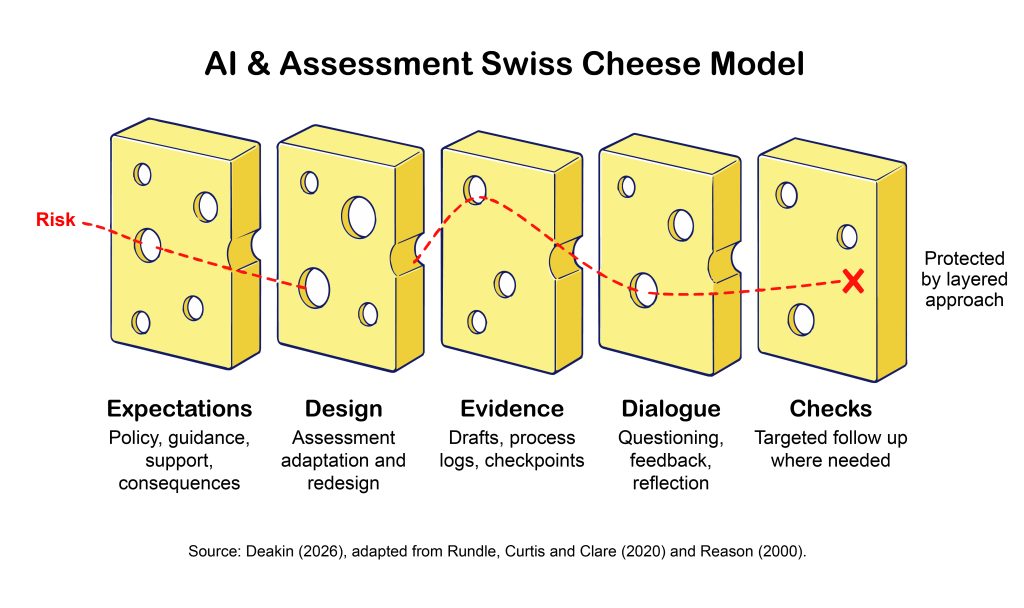
One useful way to think about this is the Swiss cheese model. Each slice of cheese is a layer of protection. Each hole is a weakness. One slice alone will always have gaps, but several slices together make it much harder for the holes to line up.
Applied to assessment, this means not relying on one defence, such as an AI detector, a plagiarism policy or a single oral presentation. Each has weaknesses. But a layered approach is stronger: clear guidance on AI use, better task design, evidence of process, careful feedback and proportionate checks where needed.
Every major technology changes what society values. The printing press reduced the need to memorise texts. Calculators reduced the need to perform complex calculations by hand. AI may reduce the value of producing routine academic work. However, none of these developments made human expertise obsolete. Instead, they force us to redefine it.
The challenge facing education is not how to keep AI out of assessment. It is how to design assessment that reveals the qualities AI cannot replace: judgement, curiosity, responsibility, ethical reasoning and the ability to make sense of an increasingly complex world.
AI cheating is not the real crisis. The real opportunity is that AI may finally be forcing education to assess the things that matter most.
The “Assessing in the age of AI: Research-informed guidance for the education sector” by Jen Deakin is now available to purchase on Amazon: https://amzn.eu/d/02P41Wut